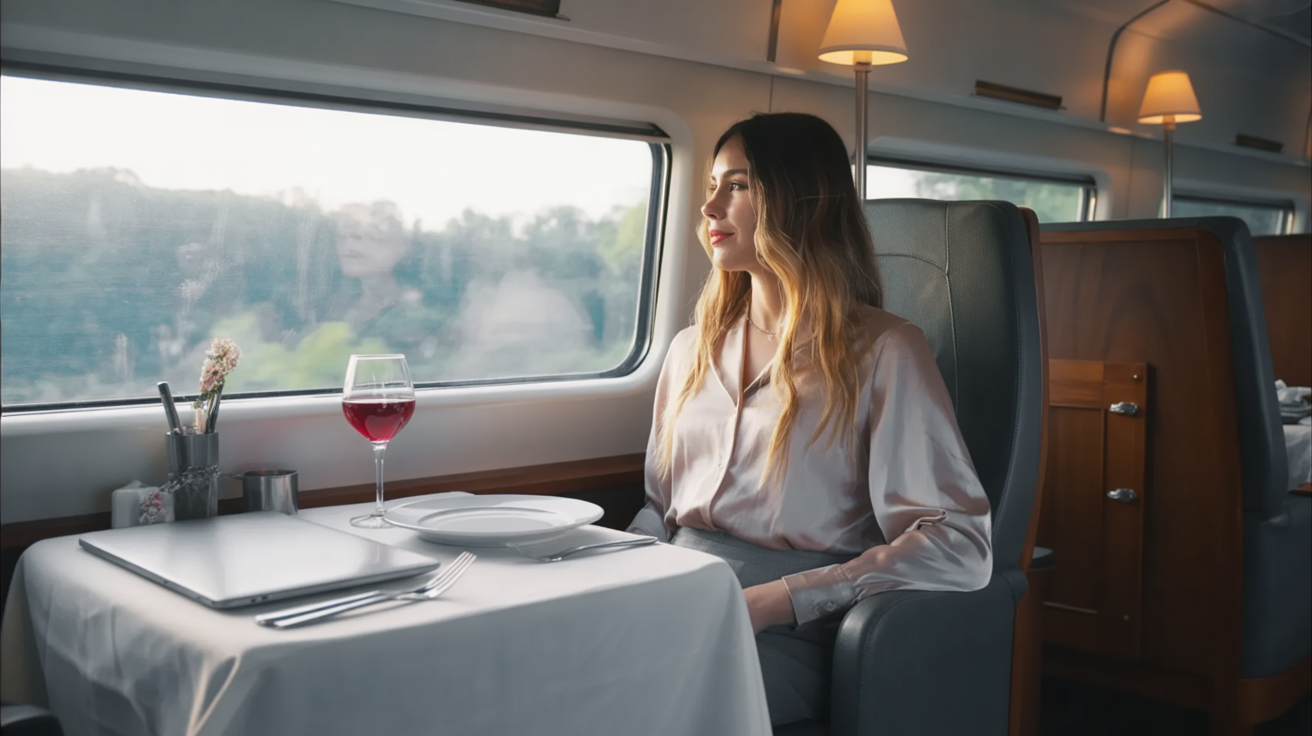
7 Reasons Train Travel Is the Underrated Secret Weapon of Digital Nomads
Planes are fast. Buses are cheap. But trains? Trains are something else entirely. For digital nomads who crave both movement and mindfulness, rail travel is one of the most overlooked lifestyle upgrades.
What makes trains different isn’t just convenience—it’s the way they reclaim the in-between. Airports are rushed and stressful, buses are often cramped and inconsistent, but trains glide steadily through landscapes that would otherwise blur past unseen. You get to feel the distance as mountains slide into fields, and small towns give way to coastal cliffs. The journey itself becomes part of the story instead of dead time to endure.
For remote workers, trains also make a surprising kind of sense. Power outlets, tables, legroom, and smooth motion mean you can actually get work done while you move. And when you pause to look up, you’re met with a changing panorama instead of another plastic airport wall.
This isn’t just about saving time or money—it’s about aligning your travel rhythm with your lifestyle. Trains sit in that sweet spot between practicality and romance, making workdays feel calmer and arrivals less frantic. Here’s why train travel might just become your secret weapon as a nomad.
You Can Actually Work While You Travel
Ask any digital nomad what their least productive days are, and nine times out of ten they’ll mention travel days. Airports eat up hours with check-ins, security, and boarding. Buses bounce along roads that make typing impossible. Flights might be quicker, but turbulence, tight seating, and airplane mode make serious work unrealistic. That’s why trains are such a hidden gem: they let you reclaim that “lost” time.
On most modern trains, you’ll find tables big enough for your laptop, power outlets to keep devices charged, and Wi-Fi that actually holds steady for emails or research. But even when Wi-Fi is spotty, trains create the perfect environment for offline work. The smooth motion means you can draft proposals, edit photos, or outline your next blog post without feeling like you’re fighting the journey.
There’s also the psychological shift. Planes feel like limbo—you’re disconnected, packed tight, and waiting for time to pass. Buses often feel draining, with stops, noise, and cramped seats. But trains? They feel like moving offices. You’re not trapped in a tin can or jostled in traffic—you’re gliding. The scenery flows past, and instead of distracting you, it creates a kind of quiet rhythm that makes deep focus easier.
Many nomads use train rides for creative work. The gentle hum and sway create the same effect as a good café: background noise without chaos. It’s perfect for writing, brainstorming, or doing the kind of “thinking work” that thrives when you’re not stressed about where your charger is or when you’ll stop next.
Practical tip: pack for train productivity. A good set of noise-canceling headphones helps you stay in your zone even if the carriage gets busy. Keep a small tote with your charger, water, snacks, and journal handy so you don’t have to rummage through your luggage. Download essential files offline in case the Wi-Fi dips.
Here’s the real payoff: instead of losing a whole day to transit, you step off the train with tasks already finished, emails answered, or ideas drafted. You don’t feel behind before you’ve even arrived. Trains don’t just take you to your next stop—they keep your momentum going, both in your travels and in your work.
🌿 Why it matters: You’re not just passing hours—you’re turning travel time into productive, meaningful time.
You See the World, Not Just the Sky
One of the biggest differences between trains and planes is perspective. On a flight, you see clouds, maybe a patchwork of fields far below, but most of the time it’s just endless sky. On a bus, you’re glued to a highway view—billboards, traffic, service stations. Neither feels particularly inspiring. Trains, though, pull you right through the heart of the landscape.
You watch fields blur into forests. Rivers weave alongside the tracks. Small towns appear, their station clocks frozen in time, and then fade into valleys or coastlines. The terrain changes in real time, and you feel the distance in your body. Instead of leaping from one city to another, you absorb everything in between.
This shift matters for digital nomads because it transforms travel days into experiences, not just transfers. Instead of describing your week as “I left Paris and arrived in Berlin,” you get to say, “I passed vineyards, watched the mountains rise, and saw villages tucked into valleys.” The in-between becomes part of the story you tell later.
There’s also something grounding about moving at a human pace. Flying can feel disorienting—you wake up in one climate and land in another with no sense of connection. Trains let you experience the gradual transition. The air shifts, the architecture changes, and you see cultures unfolding stop by stop.
Practical tip: if possible, book daytime trains for routes known for their scenery. Routes like the Bergen Railway in Norway, the Glacier Express in Switzerland, or coastal lines in Portugal aren’t just transport—they’re journeys you’ll remember for years. Keep your camera handy, but don’t forget to put it down too. Sometimes the best memories come from just watching, not documenting.
It’s not just about landscapes either. You also see glimpses of daily life—farmers working fields, kids cycling home from school, fishermen pulling nets on riverbanks. These small slices of reality remind you that your travels aren’t just about destinations—they’re about people living their lives along the way.
When you choose the train, you’re choosing to actually see the world instead of skipping over it. That shift alone can change the way you think about movement as a nomad. It stops being about rushing to the next hotspot and starts being about savoring everything in between.
🌿 Why it matters: The journey itself becomes part of your story—not just a blur between two points.
It’s Gentler on Your Nervous System
Airports are chaos disguised as order. You sprint through security lines, wrestle with luggage, sit through long boarding calls, then wedge yourself into a cramped seat. Your day is already stressful before the plane even leaves the ground. Buses aren’t much better—long waits, crowded stations, jolts that make rest impossible. By the time you arrive, you’re frazzled, tired, and behind on work.
Trains change that entirely. They move at a pace your body can actually handle. No sudden pressure shifts, no turbulence jerking your stomach, no endless queues to get inside. You arrive at the station, roll your bag a short distance, step onboard, and that’s it—you’re already in your seat. The simplicity itself is a form of calm.
For digital nomads, this matters because travel days aren’t “days off.” They’re part of your work rhythm. If every move between cities leaves you depleted, your creativity, focus, and health all suffer. Trains, with their gentle sway and unhurried rhythm, give your nervous system a break. You can sip tea, read, or dive into light work without the undercurrent of stress buzzing through your body.
There’s also something deeply grounding about train travel. The landscape doesn’t blur past like on a plane—it flows steadily outside your window. That slow transition helps your brain register change, instead of the jarring jump of flying. You feel connected to your journey, not ripped from one place and dropped into another.
Practical tip: treat train rides as recovery time. Wear cozy clothes, bring a scarf or blanket, and pack snacks you love. Instead of forcing productivity, let yourself rest if your body asks for it. Unlike flights, you don’t arrive jet-lagged or stiff—you step off the train refreshed, ready to work or explore right away.
And here’s a bonus: less bureaucracy. No liquid rules, no removing shoes, no three-hour pre-boarding windows. Just show up a little early, find your seat, and settle in. For nomads who already juggle time zones, client calls, and constant planning, this ease is priceless.
Trains don’t just move you gently through space—they move you gently through your own day. They prove that travel doesn’t have to be stressful. It can be restorative.
🌿 Why it matters: When travel stops spiking your stress, it starts feeding your energy instead.
It’s Better for the Planet
As digital nomads, we move a lot. Flights here, buses there, the occasional car rental in between. It’s exciting, but it also comes with a cost: our carbon footprint. For anyone who values freedom and exploration, there’s often a little voice in the back of your head asking, “Am I traveling in a way that respects the planet I love so much?”
Here’s where trains shine. Compared to flying or long-haul driving, rail travel is one of the most eco-friendly modes of modern transportation. A single train can carry hundreds of passengers with a fraction of the emissions per person. Many networks, especially in Europe and Asia, are powered by electricity, some even from renewable sources. That means every time you choose rail over air, you’re shrinking your footprint in a very real way.
But beyond the numbers, there’s also a mindset shift. On a plane, it’s easy to disconnect from the impact—you’re above the clouds, detached from the world below. On a train, you see the landscapes you’re moving through: the rivers, forests, farmland, and towns. It reminds you that your journey isn’t abstract—it’s connected to real places and people. That awareness naturally deepens your sense of responsibility.
Practical tip: when planning your routes, check for regional rail passes or cross-country options. In Europe, for example, an Interrail or Eurail pass can replace multiple short flights, cutting emissions drastically while saving you money. In countries like Japan, the Shinkansen (bullet train) offers speed that rivals flying, but with far less environmental impact.
The best part? Eco-friendly doesn’t mean uncomfortable. On the contrary, train travel often feels more humane: more legroom, more freedom to move, and no nickel-and-diming over baggage. You reduce your guilt and increase your comfort all at once.
Choosing trains also aligns your lifestyle with your values. Many nomads embrace minimalism, mindfulness, and living with intention. Traveling by rail reinforces that: it’s slower, more deliberate, and kinder to the planet. And when you arrive at your destination, you don’t just feel excited—you feel proud of how you got there.
🌿 Why it matters: The freedom to travel is a privilege. Choosing trains helps you protect the very world you’re so eager to explore.
You Can Pack Light — and Smart
Air travel comes with endless baggage rules. You pay extra for checked luggage, you stress about weight limits, and you silently pray your bag shows up at the carousel. Buses aren’t much better—tiny compartments, crowded racks, and the occasional horror story of bags disappearing. Trains, though, make luggage feel simple again.
Most train carriages have generous storage: overhead racks, luggage compartments at the end of each carriage, and space under the seats. Nobody’s weighing your backpack or forcing you to repack at the counter. You bring what you can carry, stash it near you, and that’s it. It’s such a relief.
This freedom changes how you think about packing. Instead of stressing about shaving off half a kilo, you can focus on packing smart. Keep a minimalist backpack with essentials—laptop, charger, headphones, Kindle, journal—beside you for easy access. Your bigger bag can rest in the luggage rack, where you’ll still see it when you walk past. Unlike flights, there’s no waiting for baggage claim or worrying about lost luggage. You step off the train, grab your bags, and you’re already moving.
Here’s a practical hack: trains are perfect for modular packing. Use compression cubes or small pouches to separate work gear, clothes, and personal items. That way, if you need to pull out your charger or sweater mid-ride, you’re not rummaging through everything. Trains give you space to spread out—take advantage of it by keeping things organized.
There’s also a psychological benefit to packing lighter for trains. When you’re not burdened by oversized luggage, boarding and disembarking become effortless. No struggling with staircases, no racing to overhead bins, no stress about fitting into a tiny trunk. You glide on and glide off, the same way the train itself moves through the world.
And let’s not forget comfort: trains allow you to keep little luxuries close without worrying about liquid limits or security confiscations. Your favorite tea bags, a thermos, a scarf for warmth—bring them. They make the ride cozier and more personal.
The beauty of train luggage freedom is that it makes travel feel like it should: simple, human, and stress-free. Instead of being defined by rules and restrictions, your journey starts the moment you board.
🌿 Why it matters: Light, smart packing means less stress, smoother travel, and more energy for the adventures waiting when you arrive.
It Feels Romantic — Even When You’re Working
There’s something about trains that feels timeless. The low hum, the gentle sway, the way the world passes in frames outside your window—it’s as if the journey itself is inviting you to slow down. Even when you’re answering emails or editing a spreadsheet, trains manage to wrap the mundane in a sense of romance.
Planes and buses rarely offer that. On a plane, you’re crammed in, cut off from the world, and counting down the hours until you can get out. On a bus, you’re jostled along highways with views of asphalt and rest stops. Neither inspires much joy. Trains, though, have a rhythm that’s softer, almost poetic. They let you settle into a groove where work feels less like a chore and more like part of the flow.
There’s also the atmosphere inside the train. Morning light spilling across your table, the quiet murmur of passengers, the occasional whistle of the engine—it creates an intimacy with the moment. You’re not rushing. You’re not disconnected. You’re simply moving, present and productive, with just enough magic woven into the routine.
For nomads, this matters more than you might think. Our lifestyle isn’t only about working from anywhere—it’s about how that work feels. The right environment can transform your energy. Answering client messages with a croissant beside you and mist curling outside your window feels different than doing it under fluorescent lights. Even small tasks gain a layer of meaning when wrapped in the romance of movement.
Practical tip: lean into the vibe. Bring a small indulgence for train days—your favorite tea, a playlist you only use while traveling, or a journal to jot down thoughts between work sessions. These rituals make the ride feel like more than just a commute; they make it an experience.
And don’t underestimate the creative spark trains provide. Many nomads find their best ideas come when they’re in motion, half-working and half-daydreaming. There’s a reason so many writers and artists have loved trains for centuries—they stir imagination while keeping you gently grounded.
🌿 Why it matters: Even when you’re working, trains give you an atmosphere that feels special. They remind you that productivity doesn’t have to be sterile—it can be beautiful, too.
You Arrive Calm, Not Frazzled
Every digital nomad knows the “arrival slump.” After a flight, you stumble through immigration lines, wait for luggage, navigate unfamiliar transport, and finally collapse at your accommodation—exhausted before you’ve even unpacked. Buses aren’t much kinder: cramped seats, long hours, chaotic terminals. By the time you arrive, you’re running on fumes, not inspiration.
Trains flip that script. Instead of stumbling off drained, you step onto the platform steady and refreshed. No jet lag, no pressurized cabin to recover from, no sprinting through endless terminals. The process is simple: board, work or rest as you wish, then step off directly into the heart of the city. Many train stations are centrally located, meaning you’re walking distance from cafés, coworking hubs, or your new apartment within minutes.
This difference is more than logistical—it’s energetic. When you arrive calm, you’re able to slip into your new routine immediately. You can meet a friend for dinner, head to a client call, or go explore without the heavy fog that comes after flights. It makes transitions smoother, and as a nomad constantly on the move, smoother transitions mean less burnout.
Another bonus? Trains are predictable. They run on clear schedules, rarely involve last-minute gate changes, and skip the security chaos that eats into your energy at airports. Knowing you won’t spend hours waiting or rushing means your nervous system stays steady from start to finish.
Practical tip: plan your arrival day intentionally. Instead of booking back-to-back commitments, use your calm arrival energy for grounding. Unpack, stretch, walk to a local café, and let yourself ease into the new rhythm. You’ll feel settled by evening instead of still catching up.
And here’s the best part: arriving calm builds excitement. Instead of being too tired to care, you look around with fresh eyes. You notice the architecture of the station, the local language on signs, the way the air feels different. The adventure begins the moment your foot hits the platform—not three days later when you’ve recovered from travel fatigue.
🌿 Why it matters: Calm arrivals set the tone. You don’t just reach your destination—you step into it ready to live, work, and thrive.
Closing Thought
For digital nomads, movement isn’t just logistics—it’s part of the lifestyle. Planes might be fast, buses might be cheap, but trains offer something neither can: balance. They’re efficient without being stressful, spacious without being sterile, romantic without being impractical. They’re the middle path that turns the in-between into something meaningful.
On a train, you’re not disconnected from the world below or stuck staring at highways. You’re gliding through landscapes, working with focus, daydreaming with ease, and arriving refreshed. The rhythm of the rails reminds you that travel doesn’t always have to feel rushed or draining—it can be restorative, even inspiring.
That’s why trains are the underrated secret weapon of digital nomads. They align with the lifestyle we’re building: one that values freedom, creativity, and intention. When you choose the train, you’re not just choosing a mode of transport—you’re choosing a way of moving through the world that feels as good as the destinations themselves.
Don’t just pass through your journey. Let it carry you.